


Training Dog to Use Dog Door: A Safe Step-by-Step Guide
Quick Answer
The best approach to training dog to use dog door is gradual, reward-based practice. Start with the flap held safely open. Reward your dog for walking through in both directions, then lower the flap little by little. Never push your dog through. Check outdoor safety before allowing independent access.
Key Takeaways
Dog-door training involves more than showing your dog an opening. Your dog must feel safe, understand the moving flap, and learn to travel both ways.
Choose a dog door that fits your dog's body and opens without causing pain or difficulty.
Reward calm interest in the flap before asking your dog to walk through it.
Start with the flap secured open so your dog can see a clear path.
Practice going outside and returning indoors as two separate training tasks.
Lower the flap in small stages, and return to an easier step if your dog hesitates.
Never push, pull, frighten, or punish your dog to make it cross the opening.
Judge progress by relaxed, willing movement rather than a fixed number of training days.
Treat safe outdoor access as a separate decision from knowing how to use the door.
Your first goal is a comfortable crossing, not unsupervised freedom. Once your dog understands the opening, you can build skill without rushing.
Before Training Dog to Use Dog Door, Check These Essentials
Start by checking the door, the floor, and the space outside. A dog may seem unwilling to learn when the real problem is poor fit or an unsafe path. Even a confident dog needs an opening it can use without strain.
Choose a quiet time for the first lessons. Keep other pets away if they crowd the opening. Have rewards ready, and make sure your dog can move freely on both sides.
Check the Door Size and Flap Movement
Your dog should pass through the opening without squeezing or scraping its body. Watch how your dog stands and moves near the frame. A small opening may force an awkward posture. A heavy flap may also be hard to push.
The American Kennel Club's guide to choosing a dog door explains why size and ease of use matter. The right fit depends on the dog and the door design.
Check the product's own sizing guide. Look at your dog's height, width, and ease of movement. If you have dogs of different sizes, each must be able to use the opening safely.
Test the flap yourself. It should move as designed, without sticking or catching. Check the edge, frame, and floor for rough spots. Follow the maker's instructions before changing any part.
If your dog has trouble bending, stepping, or lifting its paws, do not assume more practice will solve it. Physical comfort comes first.
Make the Indoor and Outdoor Areas Safe
A dog door can lead straight into danger if the yard is not secure. Check both sides before each early lesson.
Look for gaps in fences, open gates, pools, sharp tools, toxic plants, and areas where a dog could become trapped. Keep the path clear and the ground firm. A slippery step outside may make an otherwise easy crossing unpleasant.
VCA Animal Hospitals' pet-door safety guidance stresses secure fencing and outdoor hazard checks. An electronic boundary does not stop other animals from entering a yard.
Think about children as well. A young child might try to follow a dog through a large opening. The door must not create a route to unsafe outdoor areas.
Supervise practice. Keep the pet door locked when its use would be unsafe.
Choose Rewards and a Calm Practice Setting
Use something your dog truly enjoys. Small treats often work well because they are easy to give at the right moment. Praise or a short game may suit some dogs better.
Reward the action you want to see. At first, that might be one step toward the frame. Later, it could be a gentle nose touch or a full crossing.
The Oregon Humane Society's positive reinforcement guidance describes luring, capturing, and shaping. Shaping means rewarding small steps toward a larger skill.
A clear word such as 'yes' can mark the correct action. Give the reward soon after the mark. Keep the lesson calm enough for your dog to think.
Owners working on clear everyday cues can also review positive puppy commands. The same clear timing and consistent signals can support dog-door practice.
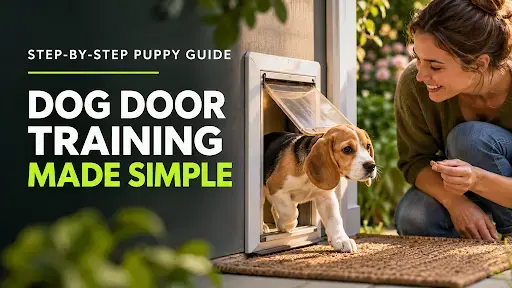
How to Train Your Dog to Use a Dog Door Step by Step
Teach the movement in easy stages. Your dog should understand one part before you add the next. Begin with the flap open, work on both directions, and slowly restore the flap to its normal position.
The AKC dog-door training guide supports a gradual process that builds comfort with the flap. The aim is voluntary movement, not forced passage.
Step 1: Reward Calm Interest in the Dog Door
Stand near the opening with your dog. Let your dog look, sniff, and explore without pressure.
If your dog walks toward the frame, mark that action and offer a reward. Reward a calm nose touch if your dog offers one. You can also gently move the flap yourself so your dog can become familiar with its sound.
Keep the movement small at first. Do not swing the flap into your dog's face.
A nervous dog may only approach from several feet away. Start there. Reward a comfortable approach and let the dog choose whether to move closer.
Your dog is ready for the next step when it can approach the opening without marked fear. Curiosity and relaxed movement matter more than speed.
Step 2: Secure the Flap Open and Reward Passage
Hold the flap fully open using a safe method approved for your door. The opening should look clear from one side to the other.
Place yourself on the far side and invite your dog through. Show a treat if needed, then reward your dog after it crosses. You may ask another family member to help from the starting side.
The PetSafe training instructions describe open-flap practice before more difficult stages. They also warn against pushing or pulling a pet through.
If your dog places only its head through, do not grab its collar and pull. Reward safe progress, then try again. The dog should choose to take the remaining steps.
Some dogs move through right away. Others need time to trust the opening. Both responses are normal reasons to adjust the pace.
Step 3: Practice Going Outside and Coming Back Inside
Passing through once is not the same as knowing both directions. A dog might follow you outside with ease but hesitate when coming home.
Practice each side as its own short lesson. Invite your dog outside, reward the crossing, then switch places. Call your dog back indoors and reward that crossing too.
The Hakuna Pets training guidance recommends practice from both sides. It also suggests starting with the direction that best motivates the pet.
Imagine your dog loves the yard. Going out may be easy. Coming inside could need a tastier reward or a calmer setting.
Avoid turning every return indoors into the end of all fun. Sometimes reward the return, pause, and continue a safe activity. The aim is to make both routes worthwhile.
Do not leave your dog outside to find its own way back before it has learned that skill.
Step 4: Lower the Flap a Little at a Time
Once your dog passes through the open doorway with ease, lower the flap partway. Your dog may now feel gentle contact while crossing.
Start with only a small change. Invite your dog through and reward a willing crossing. Watch for a pause, a sudden retreat, or a startled response.
If your dog stops, return to the last easy position. More force will not make the moving flap feel safer.
Practice both directions again. The flap may feel different as the dog enters and exits. A change in light or the view outside can also affect confidence.
Lower the flap further only when your dog remains comfortable. There is no need to complete every stage in one session.
Step 5: Teach Your Dog to Push the Closed Flap
The next goal is gentle, voluntary contact with the closed flap. Your dog must learn that pushing it creates an opening.
Begin near the last position your dog used with ease. Offer a reward on the other side, and allow time for a nose or shoulder nudge.
Mark and reward a successful push followed by passage. Avoid rewarding only the sight of food without regard to the action. Gradually keep the reward out of view until the dog moves through, then deliver it.
If the flap needs more force than your dog can manage, stop and check the door. A fit or mechanism problem is not a training failure.
Do not hold your dog against the flap. It is better to return to a partly open position than create fear of the door.
Step 6: Practice Reliable Use Without Forcing Independence
When your dog uses the closed flap, practice calm crossings from both sides. Change your position so your dog learns to use the opening without always following you.
Start close to the door. Later, you can stand farther away while keeping the area safe and supervised.
Reward correct use and keep the routine pleasant. If your dog becomes worried, simplify the lesson. One difficult attempt does not erase past progress.
A dog that can pass through alone has learned the door mechanism. That dog may still need close outdoor supervision.
For broader guidance on patient, relationship-based teaching, see NJ Puppy Whisperer's puppy-training philosophy.
Dog-Door Training Progression and Readiness Matrix
Move forward when your dog shows willing, comfortable movement. Do not advance merely because a session has ended or a certain number of days have passed.
The table below turns the training stages into clear decisions. It combines the reward-based and gradual-flap methods described above. It is a practical guide, not a tested behavior score.
Training Stage | What Success Looks Like | When to Advance | Warning Sign | Safer Next Action |
Door readiness | The opening fits, and the path is clear. | Equipment and surroundings are safe. | Flap sticks or dog cannot fit. | Fix the physical problem first. |
Flap familiarity | Dog approaches and explores willingly. | Contact with the area stays calm. | Dog backs away or freezes. | Reward approach from farther away. |
Open-flap crossing | Dog walks through without force. | Crossing is comfortable. | Dog needs pulling or pushing. | Keep the flap open and simplify. |
Two-way crossing | Dog enters and exits willingly. | Both directions feel familiar. | Dog refuses one direction. | Practice that direction separately. |
Partial-flap contact | Dog accepts light flap movement. | Contact does not cause distress. | Dog startles or retreats. | Raise the flap again. |
Closed-flap crossing | Dog pushes through on its own. | Passage is easy and voluntary. | Flap seems too heavy or painful. | Check the mechanism and fit. |
Reliable operation | Dog can use the flap from both sides. | Mechanical skill is consistent. | Dog becomes distressed or stuck. | Return to supervised, easier practice. |
The main decision is simple: change one part of the task at a time. If your dog can cross an open doorway but fears the flap touching its back, do not ask for a fully closed crossing yet.
Instead, lift the flap again. Give your dog a few comfortable chances, then try a smaller change. An easy success gives you more useful feedback than a forced attempt.
Why Your Dog Will Not Use the Dog Door
Refusal does not always mean your dog is being stubborn. The flap may feel strange, the opening may fit poorly, or the route outside may seem unsafe. Find the point where the dog stops being comfortable before changing your training plan.
Different problems need different responses. Use the following table to choose a first step without guessing at a medical or behavioral diagnosis.
What You Notice | Possible Explanation | First Safe Response | When to Seek Help |
Dog avoids the doorway. | The opening may feel unfamiliar. | Reward calm approaches. | Fear remains strong or grows worse. |
Dog stops at the flap. | Movement or touch may be unpleasant. | Hold the flap open again. | Flap contact seems painful. |
Dog exits but will not return. | Entry may be a separate challenge. | Practice indoor entry with rewards. | Fear persists despite easier steps. |
Dog cannot push the flap. | Poor fit or a stiff mechanism may interfere. | Check the door and product guide. | Pain or mobility problems appear. |
Dog rushes into the flap. | Excitement or poor control may play a role. | Slow the game and reduce difficulty. | Repeated collisions risk injury. |
Dog uses the door but has accidents. | Housetraining may still be incomplete. | Restore supervised bathroom trips. | Accidents change suddenly or seem abnormal. |
These are possible causes, not diagnoses. A dog may face more than one problem at once. Check the physical setup before treating reluctance as a behavior issue.
Your Dog Is Afraid of the Flap
The flap moves, makes noise, and may touch your dog. Those sensations can be new, even when the opening looks simple to you.
Start with the flap held still. Reward a calm look or approach. Let your dog watch you move it gently from a safe distance.
A dog that takes treats but keeps moving away may still be uncomfortable. Make the task easier. Do not keep swinging the flap to make the dog get used to it.
Your Dog Goes Out but Will Not Come Back
Train the return journey on its own. Stand indoors with a reward and make the opening easy to cross.
Your dog may enjoy running into the yard but find indoor entry less rewarding. Try a better treat or a short game after returning. Keep outdoor access supervised during training.
Check the view and ground on the indoor side. A slippery floor or crowded entry space may also discourage return trips.
Your Dog Cannot Push the Door Open
Inspect the door before asking for more effort. Look for a stiff hinge, a strong closure, a poor fit, or a frame that catches the flap.
Make sure the opening suits your dog's size and movement. Some small dogs may struggle with a flap that is easy for a larger dog.
If your dog seems sore, stiff, or unable to move comfortably, stop the exercise. Ask your veterinarian about possible physical concerns.
Your Dog Rushes, Freezes, or Avoids the Opening
A dog that rushes may be too excited to judge the space well. A dog that freezes may feel overwhelmed. Neither response calls for more pressure.
Reduce distractions and return to an easier stage. Give your dog time to choose a safe crossing.
The American Veterinary Society of Animal Behavior's training position statements support reward-based methods and advise against aversive training. Punishment and forced contact do not belong in this lesson.
If fear remains intense, seek help from a qualified reward-based trainer or behavior professional. Physical discomfort deserves veterinary attention.
How Long Does Dog-Door Training Take?
Training time varies. Some dogs may learn the basic movement within a few practice sessions. Others need more time to feel safe around the flap. A fixed deadline is less useful than seeing how your dog responds.
PetSafe gives a manufacturer example of one to three days, depending on the pet's nature. It also suggests one or two practice sessions of about ten minutes daily, followed by play. These are product-training suggestions, not a proven timeline for every dog.
Watch what changes between sessions. Does your dog approach the frame with less hesitation? Can it return indoors without following a person? Does flap contact remain comfortable?
Those signs tell you when to advance. Do not count a rushed crossing as mastery if your dog looks frightened afterward.
A new setting can also change the task. A flap may make a louder sound on a windy day. The yard may hold more distractions in the evening. Your dog might need an easier practice after such a change.
Keep sessions pleasant and stop before your dog becomes tired or upset. If a ten-minute session is too long, end earlier. The goal is learning, not meeting a timer.
Avoid comparing your dog's progress with an unsupported breed or age target. There is no verified universal success rate for dog-door training.
Can a Dog Door Help With Potty Training?
A dog door may make access to a safe yard easier, but it does not teach bathroom habits by itself. Your dog must still learn where to eliminate and what behavior earns a reward.
Imagine a puppy that walks through the flap without help. The puppy has learned how to reach the yard. It may still return inside without using the bathroom. It may also have an accident if no one notices the need to go.
The VCA puppy housetraining guidance stresses routine, supervision, and positive rewards for outdoor elimination. Owners should keep those habits in place while teaching door use.
Take your puppy outside at suitable times. Watch for signs that it needs to eliminate. Reward the correct action outdoors. Keep the bathroom routine clear instead of waiting for the puppy to use the flap on its own.
If your puppy already knows the door but still has accidents, review the house-training plan. The problem may have little to do with the flap.
NJ Puppy Whisperer's house-training guidance explains the value of a steady routine, close observation, and timely rewards.
Sudden accidents in a previously reliable dog deserve attention. Changes in urination or bowel habits can have medical causes. Contact your veterinarian if the pattern is new or unusual.
Is It Safe to Let Your Dog Use a Dog Door Alone?
Knowing how to open the flap does not prove that outdoor access is safe. Before allowing independent use, assess the space your dog will enter and the risks it may face.
The Ontario SPCA's pet-door safety guidance recommends secure outdoor areas and careful control of access. It also advises locking the door when outdoor work or other conditions create hazards.
Use this checklist before deciding how much freedom to allow. Each point concerns a real safety issue, not just your dog's training skill.
Check the fence and gates. Make sure your dog cannot escape through gaps or open exits.
Inspect the yard. Remove sharp tools, unsafe plants, and other reachable hazards.
Assess water risks. Block unsafe access to pools, ponds, or other water features.
Think about wildlife. A pet door may create access risks involving animals near your home.
Protect young children. Prevent children from using the pet opening as an exit.
Check the weather. Heat, cold, storms, and other conditions may make outdoor time unsafe.
Test the lock or access control. Confirm that the product works as its maker describes.
Consider your dog's health. Age, mobility, illness, and behavior can affect safe use.
Plan for oversight. Make sure a responsible person can supervise when needed.
If a major safety check fails, keep the dog door locked or use it only under close supervision. Do not rely on training to solve a dangerous yard condition.
Electronic pet doors may control which pet can open the flap, but they do not remove outdoor risks. A microchip reader cannot make a pool safe or prevent a dog from leaving through a broken fence.
For homes in New Jersey and elsewhere in the United States, property layout and local conditions vary. Assess your own setting rather than assuming that any one door type is safe for every home.
Remember that independent flap use and unattended outdoor access are separate choices. A dog may be skilled at the first while still needing supervision for the second.
When to Get Help With Dog-Door Training
Start by making the task easier if your dog hesitates. Many early problems can be handled by returning to an open flap, improving the reward, or removing distractions. Yet some signs call for more than another training session.
Contact your veterinarian if your dog appears to feel pain when stepping, bending, or pushing the flap. Stiffness, limping, repeated falls, or sudden trouble with a once-familiar door may point to a physical concern.
Seek a qualified reward-based trainer or behavior professional when fear is severe or does not improve with gentle changes. Help may also be useful when the dog panics outside or cannot return through a safe opening.
Do not try to overcome fear by trapping your dog on one side. Avoid withholding needed access to water, shelter, or the home as a way to force learning.
For a dog that learns slowly but remains relaxed, there may be no urgent problem. Keep the task easy, reward willing movement, and allow more practice.
If several family members use different signals, agree on a simple routine. One person should not force a crossing while another rewards calm approaches. Consistent handling makes the lesson clearer.
New Jersey owners can review NJ Puppy Whisperer's puppy-training FAQs for general service information. Ask directly about suitable support rather than assuming a dedicated dog-door program is offered.
Frequently Asked Questions About Dog-Door Training
These answers address common concerns after the first lessons. The right choice depends on your dog's comfort, the door design, and the safety of the outdoor space.
Can Puppies Learn to Use a Dog Door?
Yes, puppies can learn simple reward-based skills, including moving through an appropriate pet door. The opening must suit their size and movement. Training should be gentle and supervised.
There is no verified minimum age that works for every puppy and every door. A puppy that can cross the opening may still need help with bathroom routines and outdoor safety.
Should I Hold the Dog-Door Flap Open During Training?
Yes. Starting with a fully open flap gives your dog a clear path. It removes the need to push a moving barrier during the first crossing.
Use only a secure method suited to your door. Follow the maker's instructions. Once your dog moves through with ease, lower the flap in small stages.
Can I Push My Dog Through the Dog Door?
No. Pushing or pulling can make the doorway frightening and may cause injury. Your dog should choose to move through the opening.
Use rewards, an open flap, and a calm setting instead. If your dog refuses, make the task easier. Check for equipment problems before asking for another attempt.
How Do I Teach My Dog to Come Back Through the Door?
Practice the return trip as a separate task. Stand indoors, keep the flap open, and invite your dog back with a reward.
Reward each comfortable return. Then lower the flap gradually, just as you did for outward travel. Never leave a dog outside to work out the return route alone before it has learned the skill.
What If My Dog Is Afraid of the Flap?
Move back to a stage that feels safe. Reward your dog for looking at or approaching the flap. Let it become used to gentle movement without requiring passage.
Watch for fear signs such as retreating, freezing, or repeated refusal. If distress is intense or persists, ask a qualified professional for help.
Will a Dog Door Stop Potty Accidents?
A dog door alone will not stop accidents. It provides a route outside, but your dog still needs to learn where and when to eliminate.
Keep regular bathroom trips, close observation, and prompt rewards for outdoor toileting. If accidents start suddenly or change without a clear reason, ask your veterinarian for advice.
Can an Electronic Dog Door Make Training Easier?
Some electronic doors control access through a collar tag or microchip. That feature may suit certain homes, but it does not automatically teach a dog to push through a flap.
Follow the product's training instructions. Check the opening, access settings, and outdoor hazards. Electronic controls are not a substitute for a safe yard and suitable supervision.
A useful way to judge progress is to watch the actual movement. Can your dog approach, pass through, and return without distress? Those skills matter more than the type of door installed.
Final Takeaway: Build Confidence Before Independence
Teach the dog door as a series of small, safe movements. Begin with calm interest in the flap. Let your dog pass through an open doorway, then practice both directions. Lower the flap only when the current step feels easy.
Reward each willing crossing. If your dog stops, go back to the last comfortable stage. There is no need to force a result or finish within a set number of days.
Good training also depends on a door that fits and works well. Check the frame, the flap, and the path outside. A poor fit cannot be fixed with more treats.
Once your dog can push through the closed flap, keep checking its comfort. Practice from both sides until the movement becomes familiar. Maintain supervision as needed, even when your dog no longer needs help with the mechanism.
Do not confuse easy door use with reliable housetraining or safe time outdoors alone. Those goals need their own routines and safety checks.
The most useful outcome is a dog that can move through the opening willingly, without fear or strain. Build that confidence first. Then make any decision about greater freedom based on the dog, the yard, and the risks at home.


Comments