


Puppy Jumping on Visitors: Calm Greeting Practice at Home
Quick Answer
Puppy Jumping on Visitors: Calm Greeting Practice at Home starts with a safe, planned greeting routine. Keep your puppy behind a gate or with a handler until calm. Ask guests to pause attention during jumping, then reward four paws on the floor. Practice with a helpful visitor, and increase difficulty only when your puppy stays comfortable.
Key Takeaways
Calm greetings are skills puppies can learn through practice. These seven points will help you plan each visitor's arrival and respond safely when things get too exciting.
Puppies may jump because they feel excited, expect attention, or feel unsure around unfamiliar people.
Prepare treats, a safe boundary, and a clear visitor plan before anyone opens the front door.
Reward four paws on the floor rather than requiring every puppy to sit before receiving attention.
Ask visitors to pause greetings during jumping and give calm attention when the puppy is ready.
Practice with a familiar adult before adding doorbells, unfamiliar guests, or busy household activity.
Watch for fear or distress, and never force a worried puppy to approach or accept petting.
Track comfortable greetings and resets instead of expecting jumping to stop within a fixed number of days.
A good greeting does not always include petting. Sometimes success means your puppy stays relaxed behind a gate while visitors settle in.
Why Your Puppy Jumps on Visitors
A puppy may jump because approaching people has led to fun or attention before. The movement may also reflect excitement or worry. Check your puppy's behavior before choosing a training response.
Excitement, Attention, and Learned Greetings
Picture a guest arriving after work. Your puppy runs toward the door. The guest laughs, bends down, and pets the puppy while both front paws rest on their legs.
That reaction may feel friendly. Yet it can teach the puppy that jumping brings attention.
The Dogs Trust guide to jumping up describes excitement, attention, anxiety, and past rewards as possible reasons for jumping. These causes can overlap.
Some puppies jump more when a guest speaks loudly or moves quickly. Others leap up as soon as someone reaches for their head. A puppy may even jump higher when a person pushes them away.
The first step is to change what happens during a greeting. Make jumping less useful, then make a calm choice easy and rewarding.
When Jumping May Signal Fear or Discomfort
Not every puppy wants to meet the person at the door. A worried puppy may move forward and back, jump nervously, bark, or try to escape.
Look at the whole body. A tense stance, tucked tail, ears held back, or repeated attempts to leave may suggest discomfort. No single signal proves fear on its own.
A puppy that backs away needs space. Do not lure them close to a person they find frightening just to complete a greeting exercise.
Let the puppy watch from a comfortable place. They may choose to approach later, but contact is never required. If fear persists, seek help from a qualified reward-based professional.
Prepare Your Home Before the Door Opens
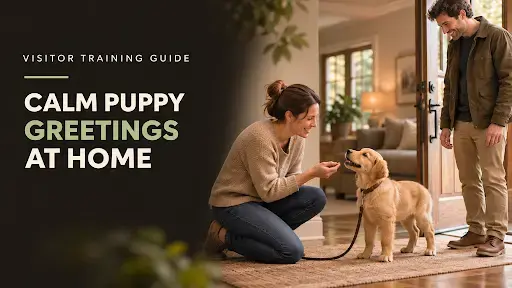
The easiest greeting to manage starts before the doorbell rings. Have rewards ready, choose where your puppy will wait, and tell the visitor what to do. A rushed greeting gives you little time to guide behavior.
Choose a Safe Boundary and Handler
A baby gate can keep a young puppy away from an open door. A comfortable leash with an adult handler may also help. Some puppies do better in a familiar resting area.
Choose a setup your puppy already knows. Check that gates are secure and cannot fall. Keep the puppy away from swinging doors and busy entry paths.
A leash should help manage access, not pull the puppy down. Do not jerk it when jumping starts. Never leave a tethered puppy unattended.
The American Kennel Club's jumping prevention advice recommends both management and training. Barriers can prevent a puppy from rehearsing a rush toward guests while learning better habits.
Assign one adult to handle the puppy. A second person can open the door if needed. This keeps the greeting from turning into a scramble for treats, collars, and door handles.
Prepare Small Rewards and One Clear Rule
Keep small, puppy-safe treats near the practice area. Your puppy should enjoy the reward and be able to eat it with ease. Account for treats in daily food intake.
Choose one simple target: four paws on the floor.
Your puppy can stand and look at the visitor. They do not have to hold a perfect sit. If your puppy already knows sit, you can use that cue when the setting is calm enough.
NJ Puppy Whisperer's positive puppy commands page covers basic skills that may support greeting practice. Teach new cues in a quiet place before asking for them at the door.
Brief Visitors Before They Enter
Tell guests what you need before they meet the puppy. Ask them to speak softly, keep their hands to themselves at first, and wait for your signal.
If the puppy jumps, they should pause the greeting. They should not pet, push, shout, or turn the moment into a game.
The AKC's guide to stopping jumping on people explains how human attention can maintain jumping. Rewarding the behavior you want gives the puppy a clearer lesson.
Keep household rules consistent. One excited greeting may undo part of your careful setup for that visit. The provider's family coaching approach also stresses shared household guidance.
Puppy Jumping on Visitors: Calm Greeting Practice at Home Step by Step
Start with a willing adult who can follow your instructions. Practice when your puppy is rested and comfortable. Work in a familiar part of the home before moving to the front door.
The aim is not a perfect greeting on the first attempt. You want a puppy who can notice a person, stay comfortable, and earn a reward for keeping their feet on the floor.
Step 1: Reward Four Paws on the Floor
Stand near your puppy in a quiet room. Wait for all four paws to touch the floor. Mark that moment with a brief word, such as 'Yes,' and offer a treat.
Move a little, then repeat. You can also take one small step toward your puppy. Reward them for staying grounded.
Do not hold food high above their head. That may invite another jump. Give the treat low enough that the puppy can take it while standing or sitting comfortably.
Keep early practice short. Stop while your puppy still wants to take part.
Step 2: Add a Familiar Adult Helper
Ask a calm adult to stand several steps away. Let your puppy notice them without rushing into contact.
Reward the puppy for standing calmly or turning back toward you. The helper should stay quiet at first.
If the puppy lunges forward or jumps, the helper can pause or move away. Increase the distance until your puppy can succeed again.
The helper's job is to make practice easier, not test how much excitement the puppy can resist.
Step 3: Practice a Slow Approach
Once your puppy stays comfortable, the helper can take a small step closer. Reward four paws on the floor before adding another step.
Change only one part of the exercise at a time. A closer visitor is already a harder task. Do not add clapping, petting, and excited speech at the same moment.
If your puppy jumps, stop the approach. Wait until everyone is settled, then restart from a greater distance.
A failed attempt gives useful feedback. It shows that this version of the exercise was too hard at that moment.
Step 4: Introduce the Doorway and Doorbell
Move practice toward the entrance once the helper approach feels easy. Keep the front door closed at first.
Ask the helper to stand near the doorway. Later, add a gentle knock or a quiet doorbell sound. Reward your puppy for noticing the sound and staying able to respond.
The doorbell can be more exciting than the person. If your puppy begins barking or rushing forward, reduce the sound or practice farther from the door.
Do not open the door while your puppy has free access to rush outside. Use the planned boundary and adult handler.
The Dogs Trust visitor training guidance explains why preparing for arrivals matters. Barking, mouthing, and jumping can all appear during guest visits, but they may need different responses.
Step 5: Allow a Brief, Calm Greeting
A relaxed puppy can try a short greeting with the helper. Ask the person to approach slowly. If the puppy stays grounded, reward that choice.
The helper may offer gentle contact if the puppy seeks it and remains comfortable. Petting is optional. Some puppies prefer to sniff and move away.
End the greeting before excitement builds. A short, successful encounter is more useful than a long greeting that ends in repeated jumping.
If your puppy wants to leave, let them. The goal is calm behavior, not compulsory contact.
Step 6: Practice With New Helpers
A skill learned with one person may not appear at once with another. Try a different cooperative adult when the first setup becomes easy.
Begin at an easier level again. A new voice, coat, bag, or style of movement can change how your puppy responds.
Do not use a busy family gathering as the first test. Real visitors may move fast, carry food, or ignore instructions.
Continue using safe barriers during ordinary visits. Remove management only when your puppy can handle that specific setting without unsafe jumping.
The Calm Visitor Greeting Practice Kit
This kit turns a broad training goal into small decisions. It shows how to raise or lower the challenge, guide guests, and review what happened. Use it during planned practice rather than relying on memory after a lively visit.
Six-Level Greeting Practice Ladder
Begin at the easiest level your puppy can manage. Move forward when the puppy stays relaxed and repeats the desired response. A setback means you should simplify the next attempt.
Level | Practice Setup | What Success Looks Like | Next Decision |
1. | Quiet room without guests. | Four paws stay down near the handler. | Add a familiar helper. |
2. | Familiar helper at a distance. | Puppy notices the person and stays comfortable. | Ask the helper to move closer. |
3. | Helper takes slow approach steps. | Puppy remains grounded or returns attention to the handler. | Move toward doorway practice. |
4. | Helper waits near the doorway. | Puppy stays manageable behind a safe boundary. | Add a mild arrival sound. |
5. | Gentle knock or reduced doorbell sound. | Puppy can recover and respond to the handler. | Try a brief greeting. |
6. | Short, voluntary greeting. | Puppy stays grounded and comfortable during contact. | Repeat with another calm helper. |
This six-level ladder is a practical teaching tool, not a tested clinical scale. No set number of attempts proves a puppy is ready to advance. Watch the puppy's behavior and adjust the task.
Before, During, and After the Door Opens
Use this short sequence when rehearsing a real arrival. It gives everyone a clear job and keeps the puppy from making the first move without guidance.
Before: Prepare rewards, secure the boundary, assign a handler, and brief the guest.
During: Reward four paws on the floor, allow calm approaches, and pause when jumping begins.
After: End the greeting while your puppy is comfortable, then record what worked and what needs to change.
If the puppy cannot cope, skip the greeting. Let the guest enter while the puppy stays in a safe area. You can practice another time.
Printable Visitor Instruction Card
A guest can help without learning a full training method. Send this message before the visit or keep it near the entrance.
Helping Our Puppy Learn Calm Greetings Please wait while we prepare the puppy. Use a calm voice and keep your hands still at first. If the puppy jumps, pause the greeting. We'll let you know when petting is welcome. Please give the puppy space if they seem worried. Thank you for helping us practice.
The card is a request, not a guarantee that everyone will cooperate. If someone cannot follow it, keep your puppy comfortably separated rather than risking an uncontrolled greeting.
Greeting Safety and Reset Decision Matrix
A jump does not always call for the same response. Look at your puppy's comfort, the visitor's needs, and the level of excitement before taking the next step.
What You Notice | What It May Mean | What to Do Now | Next Practice Choice |
Relaxed puppy jumps toward a guest. | Excitement or learned attention may play a role. | Pause attention and manage access. | Reward a calmer approach. |
Puppy stands with four paws down. | The desired action is available. | Reward promptly. | Offer brief contact if safe. |
Puppy stops responding and keeps rushing forward. | The task may be too hard. | Increase distance and pause. | Return to an easier level. |
Puppy backs away or shows tense body language. | Fear or discomfort may be present. | Stop the approach and allow space. | Work at a safe distance. |
Puppy grabs sleeves or mouths hands. | Excitement or another need may be involved. | End contact safely. | Address mouthing separately. |
Guest is unsteady or unable to follow rules. | Jumping could cause injury. | Keep a safe barrier. | Practice with another adult. |
Puppy snaps, lunges, or repeatedly panics. | A safety or behavior concern may be present. | End the greeting and create space. | Seek qualified individual help. |
This matrix helps with immediate choices. It cannot diagnose anxiety or aggression. Persistent fear, sudden behavior changes, or threatening behavior deserve individual assessment.
A Completed Greeting Progress Example
You do not need a complex score. Record what you saw, the level of practice, and the next change you plan to make.
The table shows a fictional household rehearsal. It illustrates how one owner might use the ladder without inventing a real training result.
Tracking Field | Fictional Completed Example |
Helper. | Familiar adult neighbor. |
Practice level. | Level 3: slow approach. |
Starting distance. | About six feet. |
Doorbell used. | No. |
Desired behavior. | Four paws on the floor. |
First response. | Puppy stayed grounded and accepted a treat. |
Harder attempt. | Helper moved closer; puppy jumped. |
Reset. | Helper stepped back; handler rewarded calm standing. |
Comfort check. | Puppy remained relaxed and willing to eat. |
Next practice. | Repeat at a greater distance before moving closer. |
The useful result is a better next decision. A simple log helps reveal whether distance, noise, or a visitor's actions make greetings harder. Avoid treating the number of completed levels as proof of a permanent fix.
Reset a Greeting When Your Puppy Starts Jumping
Stop the greeting calmly, then make the next attempt easier. Do not turn jumping into a struggle over the collar or leash. A safe reset teaches more than repeated correction while a puppy is highly excited.
Pause Attention Without Frightening the Puppy
For an excited puppy seeking attention, the guest can pause interaction. They might keep their hands still or turn slightly away if doing so is safe.
The handler should stop forward movement and help the puppy regain a manageable position. Reward the first suitable calm response.
The AKC's guidance on managing jumping behavior describes how access management can support training at the doorway.
Do not ignore a puppy who appears scared or trapped. Fear calls for more space, not a test of how long the puppy can tolerate distress.
Make the Next Attempt Easier
Suppose the helper approaches and your puppy jumps twice. Rather than repeating 'Sit' louder, ask the helper to move back.
Your puppy may succeed when the visitor stands farther away. Reward that response. Then decide if another small approach is worth trying.
A successful reset may end the session. There is no need to force progress each time.
The AKC's advice on effective dog training supports rewarding wanted actions and keeping training clear. Consistent rewards work best when the task fits the dog's current ability.
Avoid Physical Corrections and Forced Greetings
Do not knee a jumping puppy, push them hard, jerk the leash, or shout. These methods can frighten the puppy without teaching the greeting you want.
The American Veterinary Society of Animal Behavior's position statements favor reward-based training and oppose aversive methods. The advice applies broadly to dog training and behavior care.
Reward-based training still allows boundaries. You can block access, pause an interaction, or end a session. The difference is that your actions protect safety while helping the puppy learn a suitable choice.
Keep Greetings Safe for Children and Other Visitors
A visitor's safety comes before a training goal. Young children, older adults, people with poor balance, and guests who fear dogs may need a barrier between themselves and the puppy.
The right decision may be no greeting at all. A puppy can learn to remain settled while people visit without meeting each person.
Set Extra Rules Around Children
Adults should supervise children and puppies throughout any contact. A child should not hold the puppy's leash as the main handler or be asked to correct jumping.
Children may squeal, run, or wave their hands when excited. Such movements can make an already lively puppy harder to manage.
Have an adult direct the exercise. Use a secure gate when needed. Teach children to give the puppy space and avoid rough play near the entrance.
The site's raising puppies with kids resource offers more family-safety guidance beyond guest arrivals.
Respect Guests Who Cannot Follow the Rules
Not every visitor wants to help train a puppy. Delivery workers, contractors, and guests with limited mobility may need to enter without delay.
Do not ask them to stand in a doorway while your puppy practices. Keep the puppy in a comfortable area away from the entrance.
If the guest is afraid of dogs, respect that boundary. Your puppy does not need to greet them to have a successful visit.
Know When Home Practice Is Not Enough
Stop ordinary greeting exercises if your puppy repeatedly growls, snaps, lunges, or shows strong fear. Seek qualified help before attempting closer contact.
A veterinarian can assess sudden behavior changes, suspected pain, or signs of illness. A qualified reward-based trainer or veterinary behavior professional can help assess persistent behavior concerns.
Keep notes about what happened before the reaction. Include the visitor's actions, distance, sounds, and how your puppy responded. These details can help a professional plan safer next steps.
How Long Does Calm Greeting Training Take?
There is no fixed number of days that guarantees calm greetings. Some puppies learn the basic four-paw response quickly in a quiet room. Using that same skill near a busy doorway may take much more practice.
Progress depends on the puppy, the setting, the visitor, and past learning. It can also change during adolescence or after a stressful event.
Watch what your puppy can do without extra help. Can they notice a helper and remain grounded? Can they respond when someone knocks? Do they recover when the helper steps away?
Use those observations to choose the next exercise. A simple record is more useful than counting calendar days alone.
Keep sessions brief enough for your puppy to stay interested. The VCA Animal Hospitals' puppy training basics advises starting with short training sessions that suit a young puppy's ability to focus.
The best progress test is behavior across several safe settings. A calm response to one familiar person does not prove that an unfamiliar visitor can enter without a boundary.
Frequently Asked Questions
These answers cover common choices that arise during visitor training. Use them alongside the practice ladder, not as separate commands for every greeting. Safety and comfort still guide each decision.
Why Does My Puppy Jump Only When Visitors Arrive?
Visitors can be more exciting than familiar family members. New voices, smells, movements, and attention may raise excitement. Your puppy may also have learned that guests reward jumping. If the puppy seems worried, fear may be involved instead.
Should Guests Ignore My Puppy When It Jumps?
For safe, excited jumping, visitors can pause attention. Reward the puppy when four paws return to the floor. Do not ignore fear or distress. If your puppy becomes overwhelmed, create space and stop the greeting.
Should I Teach My Puppy to Sit Before Greeting People?
Sit can help when your puppy already knows it. It is not required. Four paws on the floor gives you a simple way to reward calm standing. Avoid repeating sit when your puppy is too excited to respond.
Can I Use a Baby Gate or Leash During Greeting Practice?
Yes, when used safely and comfortably. A secure gate can prevent a rush toward the door. An adult may use a well-fitted leash to manage distance. Never jerk the leash or leave a tethered puppy unattended.
What Should I Do If My Puppy Jumps When the Doorbell Rings?
Start by separating doorbell practice from visitor contact. Use a quiet signal if possible. Reward your puppy for staying calm or turning toward you. Add the approaching helper only after the sound becomes manageable.
What If My Puppy Is Afraid of Visitors?
Give your puppy space and a safe place to retreat. Do not force petting or lure them into close contact. Persistent fear, panic, growling, or snapping calls for qualified individual guidance.
How Many Practice Sessions Does My Puppy Need?
No set number works for every puppy. Repeat brief, comfortable exercises and check the response. Move forward when your puppy succeeds with ease. If jumping increases, return to a simpler setup rather than extending the session.
When Should I Get Professional Help for Jumping?
Seek help when jumping creates a serious injury risk, causes repeated loss of control, or occurs with fear or threatening behavior. A veterinarian should assess possible pain or sudden changes. Choose a qualified professional who uses humane, reward-based methods.
Final Takeaway: Make Calm Greetings Easier to Practice
A calm visitor greeting begins well before someone reaches the front door. Set up a safe space, agree on the visitor's role, and make four paws on the floor worth repeating.
Use planned practice to build skill. Start with a quiet room and a familiar helper. Add distance changes, doorway sounds, and short greetings only when your puppy is comfortable.
Real visits may still need a gate or separate resting area. That is a sensible choice, not a training failure. Guests can enter safely while your puppy continues learning at a suitable pace.
Keep your notes practical. Record what your puppy did, how the guest acted, and what helped the next attempt. Those facts are more useful than guessing whether your puppy was being stubborn.
For New Jersey families who want help with home greetings, NJ Puppy Whisperer's private puppy training FAQs explain the provider's approach and local service information. Confirm coverage and availability before arranging coaching.
A good greeting is not measured by how many people pet your puppy. It is measured by safety, comfort, and a response your puppy can repeat.


Comments