


Positive Reinforcement Puppy Training: How to Reward, Teach, and Build Better Habits
Quick Answer
positive reinforcement puppy training teaches good habits by rewarding actions you want your puppy to repeat. Mark the right behavior, then give something your puppy values, such as food, play, or praise. Start with easy tasks, reward promptly, and add distractions slowly. This humane method helps puppies learn without fear or harsh corrections.
Key Takeaways
Reward-based training works best when your puppy understands which action earned the reward. These seven principles will help you make each lesson clearer and more useful.
Positive reinforcement works when a pleasant consequence increases the chance that your puppy will repeat a behavior.
Mark the desired action as it happens, then deliver a reward your puppy finds valuable.
Food is useful, but toys, play, attention, and access to activities can also reinforce behavior.
Start in a quiet setting and increase distractions only when your puppy can cope with the current task.
Frequent rewards help teach new skills; established behaviors can later receive more varied reinforcement.
Prevent unsafe behavior through supervision, clear boundaries, and rewards for better choices rather than harsh punishment.
If your puppy becomes fearful, stressed, or unable to respond, reduce the challenge and consider professional support.
The goal isn't to reward every movement. It's to make a useful behavior worth repeating. One clear action, followed by one meaningful reward, is a sound place to begin.
What Is Positive Reinforcement Puppy Training?
Positive reinforcement is a learning process. When a puppy does something and receives a valued outcome, that behavior may become more likely to happen again.
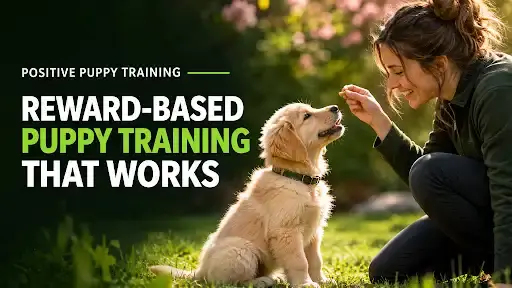
Imagine your puppy sits instead of jumping when you approach. You mark the sit with a cheerful 'Yes,' then give a small treat. With enough clear practice, sitting may become the puppy's preferred way to greet you.
The American Kennel Club's guide to reward-based training explains how food, toys, praise, and play can support this process.
The word 'positive' has a specific meaning here. It means adding something after a behavior. Reinforcement means the behavior becomes more likely in the future.
How Positive Reinforcement Changes Behavior
A successful lesson has three parts: a situation, a behavior, and a consequence.
Suppose your puppy hears their name in a quiet room. They turn toward you. You mark that moment and offer a treat. The reward follows the action you want.
Repeat the process across several easy chances. Watch whether your puppy begins turning toward you more often.
If nothing changes, the reward may be too weak. Your timing may also be unclear. A reward only functions as reinforcement when it helps strengthen the behavior.
This is why watching your puppy matters more than following a rigid formula.
Rewarding a Behavior Versus Bribing a Puppy
A treat held in front of a puppy can help guide an early movement. Trainers call this a lure. It can help a puppy discover a sitting position, for example.
But if the puppy only sits when food is visible, the lure has become part of the signal.
To move forward, stop showing food before every response. Give a familiar cue or allow the behavior to happen. Mark the action, then bring out the reward.
The puppy should learn that the behavior earns the reward, not that a visible treat must appear before the behavior starts.
Why Veterinary Behavior Experts Recommend Reward-Based Training
Reward-based methods offer a way to teach skills while protecting a dog's welfare. They also allow owners to set clear rules without using pain or intimidation.
The American Veterinary Society of Animal Behavior's position statements recommend reward-based methods for all dog training, including behavior problems. Its 2021 humane-training statement opposes the use of aversive methods, such as shock collars, prong collars, and physical punishment.
That recommendation does not mean every puppy learns at the same speed. It means the training approach should support learning without adding avoidable fear or harm.
What the Research Shows About Training and Welfare
A 2020 study published in PLOS ONE compared 92 companion dogs at seven training schools in Portugal.
Of those dogs, 42 attended reward-based schools. The other 50 attended schools using aversive methods. Researchers examined behavior, stress-related signs, saliva samples, and responses to an uncertain outcome.
Dogs in the aversive-based group showed more stress-related behavior and other signs of poorer welfare.
The study was observational. Dogs were not randomly assigned to methods, and the sample was not limited to puppies. It therefore cannot predict an exact result for your puppy.
Still, the findings add useful evidence to the welfare concerns raised by veterinary behavior experts.
Positive Reinforcement Still Includes Rules and Boundaries
Reward-based training does not mean allowing unsafe behavior.
If your puppy jumps toward a visitor, prevent repeated jumping where possible. Create space, use a suitable barrier, or arrange a calmer greeting. Then reward the puppy for keeping four paws on the floor.
Likewise, a puppy chewing an unsafe object needs protection and a suitable alternative. You can calmly remove access to the hazard, offer an appropriate chew item, and reward interest in that item.
The ASPCA's position on training methods supports humane methods that avoid unnecessary discomfort and distress.
A clear boundary tells your puppy what is safe. Reinforcement shows them which behavior is worth choosing instead.
How to Choose Rewards Your Puppy Actually Values
The best reward is one your puppy wants in that moment. A small treat may work well indoors. Outside, your puppy might prefer play, a chance to sniff, or another valued activity.
Reward value is not fixed. Your puppy's appetite, interest, surroundings, and mood can change what works.
Try two or three safe rewards during easy practice. Notice which ones help your puppy stay engaged. Use that information instead of assuming the most expensive treat is always best.
Match the Reward to the Difficulty
A simple response in a quiet room may earn regular food. A harder task near mild distractions may need a more exciting reward.
For instance, your puppy may respond to their name at home for a piece of kibble. In a quiet yard, they may be more interested in a favorite toy or a tastier treat.
Change only one part of the challenge at first. Keep the cue familiar while you test a new location or reward.
Don't keep raising reward value when your puppy appears frightened. First create more distance from the trigger or return to a calmer place.
Keep Training Treats Appropriate for Your Puppy
Food can make training precise, but many small rewards add up.
The VCA guide to training treats explains why reward size and total food intake matter. Treats should fit the dog's diet rather than provide unlimited extra calories.
For easy lessons, suitable pieces of your puppy's normal food may work. More demanding tasks might call for a different food reward.
Choose pieces your puppy can eat safely and without a long pause. Account for them in the daily food plan. Ask your veterinarian about portions if your puppy has special diet or growth needs.
Toys and play can also reduce reliance on food. Just make sure the chosen game is safe and welcome.
How to Mark and Reward the Right Moment
Good timing helps your puppy connect an action with its reward. A marker is a short signal that identifies the behavior you liked.
You might say 'Yes' the instant your puppy sits. Then you give the treat. The marker bridges the brief gap between the correct action and reward delivery.
The AKC's guidance on training rewards stresses both timing and reward placement. A reward given after an unrelated action may teach the wrong lesson.
Teach a Clear Marker Word or Clicker Signal
Choose one short sound. A clicker or a consistent word can work.
Start in a calm area. Make the sound, then offer a small reward. Repeat several times, leaving a brief pause between pairings.
Your puppy can begin to connect that sound with something good. Next, use it to mark a simple action the puppy already offers.
The VCA explanation of clicker and target training describes how a conditioned marker helps identify a desired behavior.
A clicker is not required. A clear verbal marker can suit homes where several people share puppy care. Everyone should use the chosen word in the same way.
Use the Five-Step Reward-Delivery Workflow
A simple sequence prevents many common mistakes. Before starting, decide what success will look like. Choose one small, visible action rather than a vague goal like 'behave better.'
Use this five-step method during a short lesson.
Choose one behavior. Decide whether you want eye contact, sitting, or another clear action.
Prepare an easy setting. Begin where your puppy feels safe and can focus.
Mark the exact action. Say your marker word or click as the desired behavior happens.
Deliver the reward promptly. Give something valuable without first asking for another action.
Review the response. Repeat successful chances, then adjust the reward or setting if needed.
For example, mark the moment your puppy settles on a mat. Deliver the treat on the mat so the location stays part of the lesson.
If your puppy stands before receiving the treat, improve your placement or timing. Don't turn the next attempt into a harder test.
Use Luring, Capturing, and Shaping When Appropriate
These three methods help a puppy discover the action you want.
Luring uses a reward to guide movement. You might guide the puppy into a sit, then fade the visible lure.
Capturing rewards a behavior that happens on its own. If your puppy lies calmly on a mat, mark that moment.
Shaping rewards small steps toward a goal. For example, you could reward looking at the mat, approaching it, and then stepping onto it.
The AKC's mark-and-reward introduction describes these techniques and the role of clear markers.
Use small steps your puppy can achieve. If progress stalls, return to an easier step before asking for more.
How to Build Reliable Behavior Without Increasing Pressure
A skill learned in your kitchen may not work at the park. Dogs need practice in new places, around different sounds, and near mild distractions.
The VCA guide to puppy training basics advises starting with limited distractions and adding challenges gradually.
This process is often called generalization. It helps your puppy learn that a familiar cue still matters when the surroundings change.
Start With Easy Conditions and Add Distractions Gradually
Suppose your puppy responds to their name in the living room. Try the same skill in another quiet room before moving outside.
Once the response remains comfortable and clear, add a small distraction. You might have another person sit nearby or practice in a quiet yard.
Change the setting only when the current step feels manageable. If your puppy stops responding, reduce the difficulty. More pressure won't make a loud place easier to understand.
Watch for relaxed movement, interest in rewards, and willing engagement. These signs matter more than the number of sessions completed.
For families, consistent cues also help. NJ Puppy Whisperer's training philosophy describes the provider's approach to communication and building a working relationship with a puppy.
Know When to Reduce Food Rewards
Give frequent rewards while teaching a new behavior. Once your puppy knows the skill well, you can begin changing how often food follows a successful response.
The AKC guide to reinforcement schedules explains the difference between rewarding each response and using less predictable reinforcement after learning.
Make the change slowly. Keep paying well when you increase difficulty or practice in a new place.
Food need not remain the only reward. A chance to play, go through a door safely, or continue a pleasant activity may support a learned response.
Avoid removing all rewards at once. The aim is lasting motivation, not a puppy who works only because food is visible.
The Puppy Reinforcement Decision Toolkit
When training stalls, don't assume your puppy is stubborn. Check what happened just before and after the behavior. Often, one small change can make the lesson clearer.
The toolkit below combines reward choice, timing, training difficulty, and observation. It is a practical learning aid, not a clinical test.
Use it to decide what to change during your next lesson. The goal is to spot patterns without turning each training session into a complicated experiment.
Behavior-to-Reward Matrix
Each behavior needs a clear success point. The matrix shows possible rewards and the mistakes most likely to blur that point. The choices are examples, not fixed rules for every puppy.
Desired Behavior | Moment to Mark | Possible Reward | Common Mistake | Better Adjustment |
Turning toward their name. | The puppy looks at you. | Small treat or play. | Repeating the name while distracted. | Start in a quieter room. |
Sitting during a greeting. | The puppy sits or keeps four paws down. | Treat or calm attention. | Greeting while the puppy jumps. | Make greetings less exciting. |
Settling on a mat. | The puppy rests on the mat. | Treat placed on the mat. | Rewarding after the puppy stands. | Deliver the treat in position. |
Walking with a loose leash. | The leash stays slack for a few steps. | Treat or continued walking. | Moving forward during pulling. | Reward slack-leash steps. |
Eliminating outdoors. | The puppy finishes in the right spot. | Prompt treat and praise. | Rewarding only after going indoors. | Reward at the outdoor spot. |
Entering a crate willingly. | The puppy approaches or enters by choice. | Food or a safe toy. | Forcing entry during fear. | Return to gentle introduction. |
The main pattern is timing. Reward the behavior where it happens. If your puppy changes position before receiving the treat, your reward placement may need work.
For a fuller bathroom-training approach, see the site's house training solutions. The matrix only illustrates how reinforcement applies to that skill.
Training Difficulty Ladder
A puppy can succeed in one room and struggle elsewhere. Move from easy settings toward real life in small steps.
This ladder offers a practical way to select the next challenge. It is not a fixed schedule or a tested developmental scale.
Level | Setting | What to Look For | If Your Puppy Struggles |
1 | Quiet, familiar room. | Comfortable response to a simple cue. | Improve reward value or simplify the task. |
2 | Another familiar room. | The same skill works in a new spot. | Return briefly to the first room. |
3 | Familiar place with mild distraction. | The puppy stays engaged. | Reduce the distraction. |
4 | Safe, quiet outdoor area. | The puppy responds without visible distress. | Increase distance from distractions. |
5 | Everyday setting with manageable activity. | The puppy performs the skill comfortably. | Practice in easier conditions again. |
There is no need to reach Level 5 by a certain age. One puppy may handle a new setting with ease. Another may need more practice at home.
Progress should reflect learning and comfort, not a deadline.
What to Change When Reinforcement Is Not Working
Use the first problem you can observe. Make one useful change, then see whether the next attempt improves.
Your puppy ignores the cue. Check whether the skill was taught in this setting. Reduce distractions and simplify the task.
Your puppy takes treats but doesn't repeat the action. Review marker timing and reward placement. Make the success point clearer.
Your puppy only responds when food is visible. Fade the visible lure and reward after the independent response.
Your puppy becomes overexcited. Lower stimulation and choose a calmer, easier activity.
Your puppy appears fearful or stressed. Stop increasing the challenge. Move to a safer setting and allow recovery.
A familiar skill suddenly disappears. Consider fatigue, discomfort, illness, or a major change in the environment.
Do not keep testing a puppy who looks distressed. A break may be more useful than another repetition. Seek veterinary advice for sudden physical or behavioral changes.
If one adjustment helps, keep it steady for several chances before raising the difficulty again.
Seven-Day Puppy Learning Log
A learning log helps you judge the process, not just the final result. Record the setting, reward, and response. Also note whether the puppy seemed relaxed.
Here is a completed example for an imaginary puppy learning to respond to its name. The figures illustrate how to use the tool. They are not research results or expected progress rates.
Day | Setting | Reward | Successful Responses | Observation and Next Step |
Monday | Quiet living room. | Regular food. | 4 of 6 chances. | Start with fewer distractions. |
Tuesday | Quiet living room. | Regular food. | 5 of 6 chances. | Repeat the easy setup. |
Wednesday | Another room. | Small treats. | 4 of 6 chances. | Keep practicing in the new room. |
Thursday | Another room with mild noise. | Small treats. | 3 of 6 chances. | Reduce background noise. |
Friday | Quiet room. | Favorite food reward. | 5 of 6 chances. | Repeat before adding difficulty. |
Saturday | Quiet yard. | Favorite food reward. | 3 of 6 chances. | Move farther from distractions. |
Sunday | Quiet yard, fewer distractions. | Favorite food reward. | 5 of 6 chances. | Continue with manageable practice. |
The example shows how a change in setting can affect results. A lower response count outdoors doesn't mean the puppy has forgotten everything.
For your own log, record the target behavior, opportunities, successes, setting, reward, signs of stress, and next change. Keep the notes short and honest.
A success rate can describe recorded attempts, but it doesn't measure a puppy's whole learning ability. Never use one percentage to justify pushing through fear or fatigue.
Common Positive Reinforcement Mistakes and How to Fix Them
Most reward-training problems come from unclear timing, tasks that are too hard, or rewards that don't match the situation. Fix those parts before changing the whole method.
One common error is rewarding too late. Suppose your puppy sits, stands, and then gets a treat. The puppy may not know which action earned it. Mark the sit earlier and deliver the reward where the puppy remains seated.
Another error is asking for too much at once. A puppy who sits indoors may struggle near a busy sidewalk. Instead of repeating the cue louder, find a quieter spot and reward the familiar response.
Family inconsistency also creates confusion. If one person rewards calm greetings while another encourages jumping, the puppy receives mixed lessons. Agree on a shared cue and a clear greeting rule.
For more detail on teaching basic cues, the site's positive puppy commands page provides a related training-service overview.
Visible food can become another problem. A puppy may follow the treat rather than respond to a learned cue. Use lures to introduce movement, then fade them as the puppy gains understanding.
Finally, don't ignore the puppy's emotional state. A frightened puppy needs a lower challenge, not more demands. Check the environment, allow rest, and seek help when distress persists.
When to Get Help From a Reward-Based Puppy Trainer
You can teach many simple skills at home. Professional help becomes useful when progress stalls, family members struggle to stay consistent, or behavior raises safety concerns.
A qualified trainer should explain their methods clearly. Ask what happens when a puppy makes a mistake. Look for a plan that teaches alternative behavior instead of relying on fear.
Serious aggression, intense fear, persistent panic, or risk of injury may need veterinary assessment and specialist behavior support. Don't expect a general obedience lesson to resolve a medical or complex behavior issue.
Questions to Ask Before Hiring a Trainer
Training labels can be vague. Ask about the actual methods used during sessions, not just the words on a website.
The ASPCA's dog-training resources discuss choosing professional help and avoiding unrealistic promises.
Use these questions during an initial conversation.
How do you reward a puppy when they perform the desired action?
What do you do when a puppy makes a mistake or stops responding?
Do you use shock collars, prong collars, physical corrections, or intimidation?
Can you show how you respond when a puppy becomes fearful or stressed?
What training education, qualifications, or professional experience do you have?
When would you refer a puppy to a veterinarian or behavior specialist?
Do you explain realistic goals without guaranteeing a fixed result?
Listen for clear answers. A trainer should welcome reasonable questions and explain how owners will practice between lessons.
No checklist can guarantee a good match. Your puppy's welfare and your ability to understand the method remain essential.
How in-Home Coaching Can Support Consistency
Home lessons can help families practice where daily behavior occurs. The kitchen, front door, and living room all create chances to reward useful actions.
A trainer may help family members agree on cues, reward timing, and household rules. This can reduce confusion when several people share puppy care.
NJ Puppy Whisperer describes its family coaching approach as part of its New Jersey puppy education services.
A provider's description does not prove that every puppy will achieve the same outcome. Ask how the training plan will fit your puppy's needs and how progress will be reviewed.
Frequently Asked Questions
New puppy owners often have questions after their first few lessons. These answers cover common choices about rewards, timing, age, and boundaries. The same principle runs through them all: reward a clear action while keeping your puppy safe and comfortable.
What Is Positive Reinforcement Puppy Training?
It is a learning method that adds something your puppy values after a desired behavior. The goal is to make that action more likely to happen again. Rewards might include food, play, praise, or access to a suitable activity. The result matters: a reward should help strengthen the behavior.
Can an Eight-Week-Old Puppy Learn With Positive Reinforcement?
Yes. Many puppies can begin simple reward-based learning around eight weeks old. The AKC's early puppy-training guidance discusses introducing basic lessons at this age. Keep tasks easy and practice brief. Watch your puppy's comfort and attention rather than following a strict milestone.
Does Positive Reinforcement Work Without Treats?
Yes. Food is often useful because it is easy to deliver quickly. Toys, play, attention, and access to valued activities can also reinforce behavior. Choose something your puppy genuinely wants. A reward that works indoors may be less useful near distractions.
How Quickly Should I Reward My Puppy?
Mark the correct action as it happens, then deliver the reward promptly. Clear timing helps your puppy understand what earned it. There is no single verified number of seconds that works for every training situation. Focus on accuracy and consistency.
Do I Need a Clicker to Train My Puppy?
No. A short marker word can serve the same basic purpose. First teach your puppy that the sound predicts a reward. Then use it to mark the desired action. Choose a signal that everyone in your home can use consistently.
What Should I Do If My Puppy Ignores a Reward?
Check the reward, the task, and the setting. Your puppy may prefer something else or find the environment too distracting. Try an easier lesson in a calmer place. If your puppy seems unwell or refuses food unexpectedly, contact your veterinarian.
When Can I Stop Giving Treats for Every Successful Response?
Once a behavior is well learned, you can gradually vary the rewards. Keep reinforcing the skill with food, play, praise, or other valued outcomes. Return to frequent rewards when you teach a harder version of the task. Avoid removing all reinforcement at once.
Does Positive Reinforcement Mean Never Saying No?
No. You can prevent unsafe actions, interrupt access to hazards, and set clear boundaries. The goal is to teach your puppy what to do instead. Rewarding safe alternatives is more useful than relying on fear or harsh corrections.
These answers provide starting points, not rigid rules for every puppy. If your puppy shows lasting fear, distress, or unsafe behavior, get qualified help rather than pushing through another lesson
Start With One Behavior and Build From There
You don't need to teach every skill in the first week. Choose one behavior that would make daily life easier. It might be looking toward you when called, keeping four paws on the floor, or settling on a mat.
Practice in a quiet setting. Mark the action clearly and follow with a reward your puppy values. Watch whether the response becomes easier over several chances.
If it doesn't, change one part of the setup. Try a better reward, reduce distractions, or make the task simpler. Use the decision toolkit to record what works rather than guessing.
As your puppy improves, test the skill in another manageable place. Keep the experience calm and rewarding. Some days will be easier than others, especially during growth and changes in routine.
Families can help by agreeing on the same cues and rewards. Consistency gives the puppy a clearer picture of what earns attention and other good outcomes.
New Jersey owners who want help applying these methods at home can explore relevant puppy coaching services. Ask about the training approach and how lessons will fit your puppy's age, comfort, and behavior.
Good training is not about forcing fast results. It is about helping your puppy understand useful choices and giving those choices a reason to happen again.


Comments