


How to Train a German Shepherd Puppy: Age-by-Age Training Guide
Quick Answer
To learn how to train a german shepherd puppy, start with short, reward-based lessons as soon as your puppy settles into your home. Teach attention, recall, calm greetings, leash comfort, and safe social skills first. Build harder tasks only when your puppy feels confident and responds well. Keep training through adolescence.
Key Takeaways
German Shepherd puppies need more than basic commands. These seven points help owners choose what to teach, when to move forward, and when to slow down.
Start reward-based training when your German Shepherd puppy arrives home, often around eight weeks old.
Teach voluntary attention, recall, calm greetings, leash comfort, and settling before expecting advanced obedience.
German Shepherds may be alert or reserved around strangers, but each puppy has its own temperament.
The first three months are especially valuable for safe social experiences, without forced greetings or overwhelming exposure.
Use age ranges as planning guides, not deadlines for mastering skills or reaching behavioral maturity.
Increase distance, duration, or distractions one step at a time, based on your puppy's comfort and responses.
Seek veterinary or qualified behavior support for persistent fear, threatening behavior, serious distress, or sudden behavioral changes.
A useful training plan matches your puppy's needs today. The goal is a confident dog that can learn and respond in daily life, not perfect behavior by a fixed date.
What Makes German Shepherd Puppy Training Different?
German Shepherd training should place special value on calm attention, confidence, and self-control around everyday distractions. These skills help an alert, active puppy learn how to live with people.
The German Shepherd Dog Club of America's breed standard describes an ideal dog as confident and alert, with some reserve toward strangers. It does not describe hostility, fear, or nervous behavior as desirable traits.
That standard describes the breed ideal. It cannot predict how your puppy will behave. Health, breeding, past experiences, and daily learning all play a part.
The American Kennel Club's German Shepherd breed guidance also stresses early socialization and ongoing training. A puppy may learn quickly in a quiet room yet struggle near moving people or other dogs.
Train for Confidence, Not Forced Friendliness
Your puppy does not need to greet every stranger. Calmly watching someone pass can be a successful social experience.
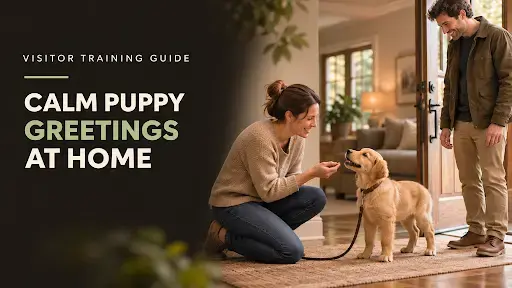
Imagine a visitor arriving at your front door. Keep your puppy at a comfortable distance, using a gate or leash if needed. Reward relaxed observation and voluntary attention toward you.
If the puppy wants to approach and remains comfortable, allow a calm choice. If it retreats, freezes, or looks worried, increase the distance.
The aim is not to make your puppy suspicious or overly friendly. It is to help the puppy feel safe around people without losing control.
Balance Engagement, Play, and Rest
A lively German Shepherd may find movement very exciting. Running children, bouncing toys, and visitors can make familiar cues harder to follow.
Use short training games between normal parts of the day. Reward a calm pause after play. Give your puppy a quiet place to rest.
The RSPCA's puppy-care advice supports positive experiences, gentle handling, routines, and rest.
Avoid trying to solve excitement with long forced runs or repeated high-impact exercise. Growing puppies need suitable activity and recovery. Ask your veterinarian about strenuous exercise and physical development.
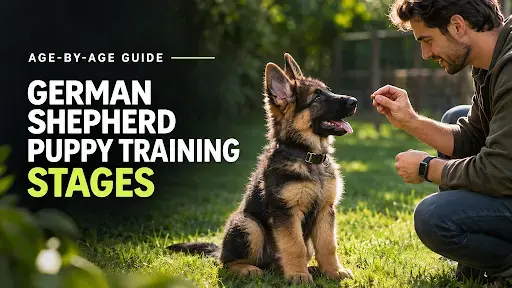
How to Train a German Shepherd Puppy: Start With Five Priorities
Start with skills that help your puppy succeed at home. Clear communication matters more than teaching many commands at once.
The American Veterinary Society of Animal Behavior's humane training position recommends reward-based training and advises against aversive methods. Avoid shock collars, prong collars, frightening corrections, and punishment-based dominance methods.
1. Build Trust and Reward Voluntary Attention
Begin in a quiet room. When your puppy looks toward you, say a brief marker word such as 'yes' and give a small reward.
You can also say the puppy's name once and reward a friendly response. Stop before your puppy loses interest.
This skill becomes useful later. A puppy that checks in with you is easier to guide near visitors, movement, or other distractions.
For help with the basics, see positive puppy commands and foundation training.
2. Teach a Happy Recall in a Safe Setting
Call your puppy from a short distance indoors. Reward the puppy for moving toward you. Keep the game pleasant and easy.
Do not expect the same response outdoors. A moving bird or passing dog may be far more interesting than your voice.
Use secure spaces or suitable leash control while recall develops. Never rely on an untested cue near traffic or other hazards.
3. Practice Calm Greetings and Four Paws on the Floor
German Shepherd puppies may jump during exciting greetings. Prevent repeated jumping by managing access to visitors.
Ask a calm helper to stand nearby. Reward the puppy when all four paws stay on the floor. If excitement rises, create more space and try an easier greeting.
Do not push the puppy down or treat jumping as a challenge to your authority.
4. Introduce Comfortable Leash and Handling Skills
Let your puppy inspect a suitable harness or leash. Reward calm contact before asking the puppy to wear it briefly.
During safe indoor practice, reward staying near you. A short, relaxed walk together is a useful start.
Also introduce gentle handling of paws, ears, and the body. Stop when the puppy shows discomfort. Build cooperation instead of forcing contact.
5. Reward Settling and Everyday Cooperation
A German Shepherd puppy also needs to learn when nothing exciting is happening.
Reward quiet moments on a mat or bed. Practice after play, while someone prepares food, or when family members move through the room.
Keep toilet breaks, meals, and rest predictable. The RSPCA's dog training guidance supports short, regular lessons and rewards that the dog values.
These five skills work together. Attention helps recall. Calm greetings help social confidence. Settling gives your puppy another way to respond when life gets busy.
German Shepherd Puppy Training Timeline by Age
Begin with simple home skills, then add real-world challenges as your puppy grows. Training should continue well beyond the first few months.
The AKC's German Shepherd puppy training timeline covers development from about eight weeks to two years. Its stages offer helpful guidance, not fixed achievement dates.
8–12 Weeks: Trust, Routines, and Safe Exploration
Help your puppy feel secure at home. Focus on name response, gentle handling, supervised play, and calm contact with family members.
A first-week routine might include a short attention game after waking, toilet opportunities after rest, gentle play, and a calm encounter with a normal household sound.
Let the puppy rest between activities. You do not need a long training session to make progress.
Bathroom routines and crate comfort also matter. Detailed help is available through house-training routines and positive crate conditioning.
12–16 Weeks: Recall, Leash Foundations, and Social Confidence
Continue easy recall and attention games. Begin to use known skills around mild distractions.
For instance, reward your puppy for looking toward you while a person walks past at a comfortable distance. The puppy does not need to meet that person.
The AKC's updated general puppy training timeline emphasizes early trust, structure, and continued learning.
Ask your veterinarian which outings and classes suit your puppy's vaccination status and local disease risks.
4–6 Months: Calm Manners and Consistent Responses
Practice brief waits, calm greetings, settling after play, and walking near you in manageable settings.
Your puppy may become more interested in movement and other dogs. Teething and changing rest needs can also affect daily behavior.
If a known cue stops working near visitors, move farther away. Reward attention at the easier distance before trying again.
6–12 Months: Maintaining Skills Through Adolescence
Adolescence can make old skills seem less steady. Keep rewarding good responses instead of assuming your puppy is being stubborn.
Practice recall with safe containment or a suitable long line. Reward your dog for turning away from mild distractions and checking in.
Vary the setting only when your dog is ready. A quiet park edge may be easier than a crowded path.
Owners seeking tailored help can explore advanced puppy development and confidence training, which describes age-aware work on focus, play, confidence, and manners.
12–24 Months: Building Real-World Reliability
Continue using learned skills in varied, safe settings. Work on calm responses near people, dogs, traffic sounds, and household activity.
Some dogs need much more time with certain distractions. There is no single birthday when every German Shepherd becomes fully mature or reliably trained.
Keep rewards meaningful. Maintain safe leash control where needed. A dog that responds well at home may still need practice in unfamiliar places.
German Shepherd Puppy Training Progression and Decision Matrix
Use this matrix to decide what to practice next. It links age, real-world situations, and signs of readiness.
The age bands are an editorial guide based on the sources above and the AAHA's canine behavioral development guidance. They are not a tested schedule or clinical scoring tool.
How to Use the Age-by-Skill Matrix
Find your puppy's current stage. Pick one useful situation. Start where the puppy can stay comfortable and engaged, then change one challenge at a time.
Developmental Stage | Main Priority | Real-World Practice | Observable Success | Advance When | Simplify or Seek Help When |
8–12 weeks | Trust and attention. | Reward a calm check-in during home activity. | Puppy joins willingly and accepts a reward. | Familiar sounds no longer interrupt easy practice. | Puppy hides, freezes, or avoids the activity. |
12–16 weeks | Recall and safe social confidence. | Reward attention while a visitor stands far away. | Puppy notices the visitor and can look back. | Calm responses continue at the current distance. | Puppy becomes worried or cannot reengage. |
4–6 months | Greetings and settling. | Reward four paws down and calm time after play. | Puppy can settle with suitable support. | The same task works with a mild distraction. | Excitement keeps rising or play becomes unsafe. |
6–12 months | Adolescent focus and recall. | Practice turning away from movement on a safe line. | Puppy responds willingly in a managed setting. | Responses stay steady across several safe sessions. | Puppy lunges, panics, or repeatedly loses focus. |
12–24 months | Everyday reliability. | Practice calm walking and familiar cues in new places. | Dog responds comfortably across suitable settings. | One new challenge is manageable without force. | Fear, distress, or unsafe responses persist. |
The matrix is a decision aid, not a promise. A six-month-old puppy may still need an exercise listed for a younger stage. Returning to that step is sensible training.
Readiness Checklist: Increase Difficulty or Make It Easier?
Before adding a new challenge, check how your puppy behaves. These six signs can help you make a safer choice.
Your puppy joins the exercise willingly instead of hiding, freezing, or resisting.
Your puppy can respond to an easy, familiar cue in the current setting.
Your puppy seems comfortable enough to explore, play, or accept a suitable reward.
Your puppy can recover from mild novelty when given enough space.
Your puppy can complete the current task without force or frightening corrections.
You can keep your puppy safe if a cue fails during practice.
These checks are not a medical test. A puppy may refuse food because it is full, worried, or distracted. Look at the full situation rather than one sign.
If practice feels easy and relaxed, add one small challenge. If fear or repeated failure appears, reduce the task or stop.
Socializing a German Shepherd Puppy Without Overwhelming Them
Safe socialization helps a German Shepherd puppy learn that new experiences can be manageable. It does not require meeting every person or dog.
The AVSAB puppy socialization position identifies the first three months as especially important. Learning still continues after that early period.
Practice Calm Observation Before Greetings
Start at a distance where your puppy can notice a new sight without showing strong fear.
You might sit with your puppy near a quiet path. Let the puppy watch a person pass, then reward calm attention. Leave while the experience remains comfortable.
Different surfaces, ordinary sounds, and calm visitors can also offer useful learning. Do not force your puppy toward a person or object.
The AAHA guidance on age and behavior warns that forced exposure may make fear worse.
If your puppy freezes or tries to escape, increase the distance. Allow time to recover. Strong or ongoing fear needs skilled advice.
Balance Early Exposure With Vaccination Safety
Some controlled puppy classes may begin before the full vaccine series is complete, with suitable health precautions.
AVSAB's guidance describes a starting age of about seven to eight weeks for appropriate classes. It also specifies vaccine timing, deworming, and ongoing vaccine care.
These conditions do not make every class safe for every puppy. Ask your veterinarian about local disease risk, vaccine status, class hygiene, and contact with unfamiliar dogs.
Avoid uncontrolled dog-park exposure before your veterinarian considers it suitable. Watching the world from a safe distance can still be valuable.
Common German Shepherd Puppy Training Problems and First Responses
Many puppy problems arise when excitement, fear, or distraction exceeds the puppy's current skills. Similar behavior can have different causes.
Do not label a puppy aggressive or dominant based on one incident. Look at the setting, the puppy's body language, and what happened before the behavior.
The table gives safe first responses. It cannot diagnose a behavior or medical condition.
Observed Situation | Possible Explanation | First Safe Adjustment | When to Seek Help |
Jumping at guests. | Excitement or a learned greeting habit. | Manage access and reward four paws down. | Threatening behavior or severe distress appears. |
Grabbing hands or clothing. | Play, frustration, or teething discomfort. | Offer a safe toy, pause play, and allow rest. | Biting causes injury or escalates. |
Pulling toward people or dogs. | Curiosity, excitement, fear, or learned pulling. | Add distance and reward voluntary attention. | Panic, hard lunging, or unsafe behavior persists. |
Freezing near strangers. | Fear or uncertainty. | Increase distance and allow choice. | Fear persists or grows worse. |
Ignoring outdoor recall. | Distractions exceed current skill. | Use safe control and return to easy practice. | Recall failures create ongoing safety risks. |
Resisting familiar handling. | Pain, fear, illness, or discomfort. | Stop handling and assess the change. | Sudden, painful, or lasting changes occur. |
A puppy that pulls toward another dog may be eager to play or trying to escape. Those situations call for different long-term plans, even though increasing distance can help both.
Jumping, Mouthing, and Grabbing Clothing
Prevent frantic greetings by using a gate or enough space. Reward calm behavior before allowing closer contact.
During play, a puppy may grab sleeves or hands. Pause the interaction and offer a suitable toy. End the game if excitement keeps climbing.
Do not use physical intimidation or harsh corrections. If biting is injurious or linked with fear, seek a qualified assessment.
Pulling Toward People, Dogs, or Movement
Movement can be exciting for an alert puppy. Start far enough away that your dog can notice the distraction and still respond.
Reward a voluntary look back toward you. If pulling grows stronger, increase distance instead of jerking the leash.
Keep a secure hold and choose settings where you can manage the situation safely.
Freezing, Avoiding Strangers, or Ignoring Recall
Freezing may signal fear or uncertainty. Do not force an introduction to prove that the puppy is brave.
A missed recall can have a simpler cause. The puppy may not know the cue well enough in that setting.
Move to a safer, quieter area and try an easy version. Persistent fear, panic, or threatening behavior deserves professional advice.
How to Track Progress Without Rushing Your Puppy
Track comfort and context, not just correct responses. A puppy may do well in one room but struggle near visitors or moving cars.
A brief record helps you see which setting is too hard. It also shows whether a change improves the next lesson.
Record Comfort and Context Alongside Correct Responses
The following completed example is fictional. It shows how to make training decisions without using invented success rates.
Puppy Age | Skill | Practice Setting | Distraction | Observed Result | Next Adjustment |
14 weeks | Attention. | Quiet kitchen. | Low. | Looked back willingly. | Try another calm room. |
14 weeks | Attention. | Front room near visitor. | Moderate. | Watched visitor and stopped responding. | Add distance from visitor. |
14 weeks | Attention. | Front room with visitor farther away. | Low. | Checked in and stayed relaxed. | Repeat this easier setup. |
The example shows that distance can change the task. A missed response does not prove your puppy forgot the lesson.
Keep notes simple. Record whether your puppy joined willingly, needed help, or was not ready for that setting.
Change One Challenge at a Time
Training difficulty has three useful parts: distance, duration, and distraction.
Distance is how far your puppy is from a person or object. Duration is how long the task lasts. Distraction is what else happens nearby.
Change only one part at first. If your puppy responds well near a quiet visitor, try a slightly closer position. Do not also add loud sounds and a longer wait.
A short successful lesson is more useful than repeated failure. Stop before frustration takes over.
When Should You Get Help From a Trainer or Veterinarian?
Choose support based on safety, comfort, and progress. Mild puppy excitement may improve with home practice. Serious distress or sudden behavior changes need a different response.
The AAHA behavior management guidelines stress early attention to concerning behavior. Owners should not assume severe fear or aggression will simply disappear with age.
When Home Practice Is Reasonable
Home practice may suit ordinary mouthing, mild jumping, and early leash or recall learning when the behavior remains safe and manageable.
Use rewards, gates, suitable toys, short lessons, and calm routines. Watch whether your puppy becomes more comfortable over time.
If progress stops, review the setting before making the lesson harder.
When Personalized Training May Help
A reward-based trainer may help when your puppy struggles with visitors, movement, or changing settings. Coaching can also help families use the same cues and routines.
Ask how the trainer handles fear, mistakes, and unwanted behavior. Favor clear plans that rely on rewards and safe management.
For New Jersey owners considering local coaching, NJ Puppy Whisperer's puppy training FAQs provide information about its training services. Review any trainer's methods before booking.
When Veterinary or Behavior Support Is Important
Seek veterinary advice for sudden behavior changes, suspected pain, serious distress, marked withdrawal, or worsening fear.
Repeated threatening behavior or unsafe biting also needs prompt professional attention. Your veterinarian may recommend a qualified behavior specialist.
Do not attempt to diagnose a disorder from a checklist. Stop unsafe training situations while you arrange suitable support.
Frequently Asked Questions About German Shepherd Puppy Training
These answers cover common concerns about timing, behavior, and safe training choices. They should be read alongside your puppy's own health, comfort, and learning history.
Can You Start Training a German Shepherd Puppy at Eight Weeks?
Yes. Many German Shepherd puppies can begin easy reward-based lessons around eight weeks, when they arrive home. Start with attention, calm contact, gentle handling, and household routines. Allow plenty of rest.
What Should a German Shepherd Puppy Learn First?
Begin with voluntary attention and name response. Add happy recall, calm greetings, comfortable leash handling, and settling. These skills support safe daily life and make later training easier.
How Long Should German Shepherd Puppy Training Sessions Last?
Keep early sessions brief and enjoyable. A few minutes may be enough for a young puppy. Stop sooner if attention fades or stress appears. There is no fixed daily training quota that suits every puppy.
How Do You Stop a German Shepherd Puppy From Jumping on People?
Manage greetings so your puppy cannot keep practicing jumping. Reward four paws on the floor. Use calm helpers and enough space. Make greetings easier when excitement rises.
How Can You Socialize a German Shepherd Puppy Before Full Vaccination?
Ask your veterinarian which controlled experiences are safe. Suitable puppy classes, calm visitors, and observation from a safe distance may help. Avoid uncontrolled exposure to unknown dogs or high-risk areas.
Does a German Shepherd Puppy Need Guard or Protection Training?
No. A family German Shepherd does not need guard or protection training to learn good manners. Focus on confidence, reliable everyday cues, safe social skills, and calm behavior around people. Protection work is not part of basic puppy training.
When Should You Ask a Professional for Help?
Seek advice when fear grows worse, biting becomes unsafe, or your puppy shows serious distress. Sudden behavior changes or suspected pain call for veterinary care. A qualified reward-based trainer can help with persistent learning challenges.
The age of your puppy alone should not decide whether help is needed. Safety, comfort, and the pattern of behavior matter more.
Keep Building Skills as Your German Shepherd Grows
German Shepherd puppy training works best as an ongoing process. Choose one useful skill, practice it in a safe setting, and watch how your puppy responds.
Start with something your puppy can already do. Reward a willing response. If the task feels easy, change one small part. If your puppy becomes worried or distracted, return to the simpler version.
As your dog grows, repeat familiar lessons in suitable new places. Maintain safe boundaries while recall and calm manners improve. Remember that even a skilled young dog may struggle with a new or exciting setting.
Your German Shepherd does not need to match a fixed training deadline. Steady rewards, thoughtful practice, safe exposure, and rest provide a stronger foundation than pressure or punishment.
If progress becomes difficult, consider tailored, reward-based coaching that fits your puppy's age, temperament, and home routine. The aim is not to rush development. It is to help your dog learn skills that remain useful through adult life.


Comments